

Author

MS, CFP®, CAP®, AEP®
Subscribe to Newsletter
Related Posts
Philanthropic Planning Insights
July 01, 2026
What is a donor-advised fund? It’s a question every financial professional should be able to answer.

Key Takeaways
- A donor-advised fund (DAF) is a charitable giving account held by a sponsoring public charity.
- Tax efficiency, simplicity compared with private foundations, and ability to accept complex non-cash assets have pushed DAF assets past a quarter of a trillion dollars.
- Rules around DAFs are still evolving; advisors who understand them deeply are the ones who will guide clients’ generosity well.
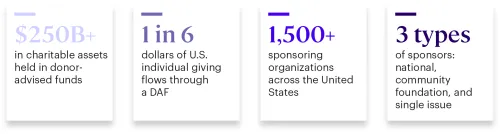
Ask ten financial advisors what a donor-advised fund is, and you will get ten answers that are mostly right. Mostly right is no longer good enough. Donor-advised funds now hold more than a quarter of a trillion dollars in charitable assets, and roughly one out of every six dollars Americans give to charity flows through one, according to the Annual DAF Report produced by the Donor Advised Fund Research Collaborative. When a vehicle becomes that central to how clients give, "mostly right" becomes a professional liability.
So, let's answer the question properly.
Donor-Advised Fund Definition: What the Law Actually Says
A donor-advised fund, or DAF, is a charitable giving account held and administered by a 501(c)(3) public charity known as a sponsoring organization. The donor makes an irrevocable contribution to the sponsor, receives an immediate charitable income tax deduction, and retains advisory privileges to recommend how the assets are invested and which qualified charities receive grants over time.
Congress gave DAFs their first statutory definition in the Pension Protection Act of 2006, codified at Section 4966 of the Internal Revenue Code. Three elements make an account a DAF: it is separately identified by reference to contributions of a donor, it is owned and controlled by a sponsoring organization, and the donor (or someone the donor appoints) has advisory privileges over distributions or investments. All three must be present. That definition matters more than it might seem, because proposed Treasury regulations continue to refine which accounts and which advisors fall inside it.
The word that does the heavy lifting is “advisory.” The donor recommends. The sponsor decides. In practice, sponsors approve the overwhelming majority of grant recommendations to qualified public charities, but the legal distinction is what makes the immediate deduction possible. The gift is complete when it reaches the sponsor, not when a grant eventually reaches an operating charity.
How Do Donor-Advised Funds Work?
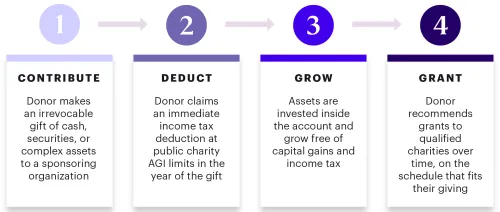
The lifecycle of a DAF is simple to describe. A donor contributes cash, appreciated securities, or in many cases far more complex assets to a sponsoring organization. The donor claims a deduction in the year of the gift, subject to the AGI limitations that apply to gifts to public charities, which are more generous than the limits for private foundations. The contributed assets are invested inside the account and grow free of capital gains and income tax. Over time, the donor recommends grants to the charities they care about, on whatever schedule fits their giving.
Sponsoring organizations come in three broad types. National sponsors, such as those affiliated with major financial institutions, hold the majority of DAF assets. Community foundations pair DAF administration with deep local knowledge. Single-issue charities, including universities, faith-based organizations, and federations, sponsor DAFs connected to their missions. As of the most recent Annual DAF Report, more than 1,500 sponsoring organizations operate in the United States, so the choice of sponsor is itself a planning decision.
Donor-Advised Fund Tax Benefits and Why the Vehicle Has Grown So Fast
Three forces explain the growth. The first is the donor-advised fund tax deduction. A donor who contributes long-term appreciated stock to a DAF deducts the fair market value and permanently avoids the capital gain, which can increase the amount available for charity by 20 percent or more compared with selling and giving cash. Since the 2017 tax law raised the standard deduction, DAFs have also become the natural home for bunching, where a client concentrates several years of giving into one tax year to itemize, then grants the funds out over time.
The second is simplicity relative to the alternatives. A DAF delivers much of what a private foundation offers, organized giving, family involvement, and investment growth, without excise taxes, annual filings, or a five percent minimum distribution requirement, and at a fraction of the cost.
The third force is the one closest to my own practice: non-cash assets. At one major national sponsor, well over half of contributed dollars now arrive as something other than cash, and Fidelity Charitable reported a fourteenfold jump in cryptocurrency contributions in a single year. Real estate, closely held business interests, restricted stock, and digital assets are all finding their way into DAFs, often ahead of a liquidity event. This is where the planning gets genuinely sophisticated, and where advisors either add enormous value or create enormous problems. The prearranged sale doctrine, assignment of income, qualified appraisal requirements, and unrelated business income tax all live in this territory.
Donor-Advised Fund or Private Foundation?
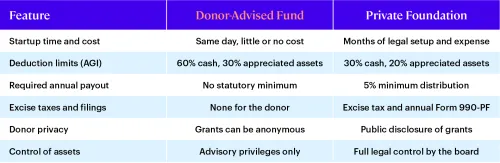
The comparison clients ask about most is the donor-advised fund vs private foundation decision. A DAF wins on speed, cost, deduction limits, and privacy. A private foundation wins on control, governance, and the ability to employ family members, run programs, and make certain grants a DAF cannot. Many families use both, pairing a foundation for legacy governance with a DAF for flexibility, anonymity, and complex asset gifts. The right answer is rarely ideological. It is a function of the client's assets, family, and intent.
Donor-Advised Fund Rules Advisors Get Wrong
A few misconceptions come up constantly. The first is treating the DAF as the donor's money. It is not. Once contributed, the assets belong to the sponsor, and the donor's rights are advisory. Clients who hear this for the first time at the point of a denied grant recommendation are clients who were poorly advised.
The second is assuming a DAF grant can satisfy anything. Under current donor-advised fund rules, grants cannot fulfill a legally enforceable personal pledge without care, cannot pay for event tickets or memberships that carry more than incidental benefits, and cannot go to individuals. IRS Notice 2017-73 and the regulatory activity that has followed it continue to shape these rules, and advisors who learned them once and moved on are working from stale information.
The third is ignoring the succession question. Every DAF needs a plan for what happens at the donor's death: successor advisors, named charitable beneficiaries, or an endowed fund at the sponsor. A DAF without a succession plan is an estate planning gap hiding in plain sight, and pairing DAFs with charitable remainder trusts, gift annuities, and bequests is some of the most valuable work a planner can do.
Donor-Advised Fund Pros and Cons: The Payout Debate
It is also worth acknowledging the live policy debate, because any honest accounting of donor-advised fund pros and cons has to include it. Critics point out that DAFs carry no statutory payout requirement and offer limited account-level transparency, and reform proposals surface in Congress with some regularity. Sponsors counter with aggregate payout rates well above the private foundation minimum. Advisors do not need to take a side, but they do need to be conversant, because clients read the same headlines we do.
How to Set Up a Donor-Advised Fund
For clients ready to act, setting up a donor-advised fund is refreshingly straightforward. Choose a sponsoring organization whose investment options, minimums, fees, and gift acceptance capabilities fit the client, especially if complex assets are on the table. Complete the fund agreement, which typically takes minutes for cash and marketable securities. Fund the account, ideally with the most appreciated eligible asset in the portfolio rather than cash. Then name successor advisors or charitable beneficiaries on day one, not someday. The mechanics are easy. The strategy around them is where an advisor earns their keep.
Why We Created the DAFCP™ Designation
Here is the honest observation behind everything above: the fastest growing vehicle in American philanthropy has, until recently, had no dedicated professional education standing behind it. Advisors learned DAFs in fragments: a CE session here, a sponsor's marketing piece there. That gap is why The American College of Financial Services created the Donor-Advised Fund Certified Professional™ Program and the DAFCP™ designation.
The DAFCP™ curriculum takes everything this article touches and treats it with the depth it deserves: six units and 26 course lessons spanning DAF fundamentals and the statutory framework, charitable deduction and bunching strategy, gift acceptance and the valuation of complex assets, grantmaking rules and grant administration, estate planning and DAF succession, and ethics, compliance, and technology, including the court cases and IRS guidance reshaping the field. An immersive case study runs through all six units, and the program culminates in a proctored final exam through Pearson VUE.
We built it for the full ecosystem around these funds: financial advisors, nonprofit and philanthropic professionals, attorneys, and CPAs. Donor-advised funds sit at the intersection of tax law, investment management, estate planning, and charitable intent, and no single profession owns that intersection. Broadening real education about DAFs across all of these disciplines is the point.
So, what is a donor-advised fund? It is a deceptively simple account sitting on top of a genuinely complex body of law, and it is where a growing share of your clients' generosity already lives. The advisors who understand it deeply will guide that generosity well. That is a standard worth certifying.
More on DAFs and Philanthropic Planning
- Learn more about the DAFCP™ Program
- Explore the Center for Philanthropy and Social Impact
- Browse insights on philanthropic planning
Related Posts