

Subscribe to Newsletter
Related Posts
August 25, 2026
Trump accounts are officially live, and with the savings vehicle active, there are several topics parents should learn more about when setting up an account for their children.
This article originally appeared in the July 2026 issue of Keep More Quarterly and is shared here with express permission from Ed Slott and Company, LLC. All rights reserved. Ed Slott, CPA, is a professor of practice at The American College of Financial Services.
What to Know About Trump Accounts
- Trump accounts are special savings vehicles meant for children, but they have a few specific rules that account holders and managers need to keep in mind.
- Several different types of contributions can be made to Trump accounts, and leveraging all areas allows you to get the most out of the account.
- If used properly, according to analysts, Trump accounts can be a powerful savings vehicle for later in life.
Trump Accounts are Now Open
One of the most talked-about provisions of the One Big Beautiful Bill Act (OBBBA), signed into law on July 4, 2025, is a new savings vehicle for children called "Trump accounts." These accounts are unusual. They are considered traditional (non-Roth) IRAs. However, until the year the child turns age 18, they are subject to special rules that normally do not apply to traditional IRAs. Starting in the year the child turns age 18, Trump accounts become subject to most of the normal traditional IRA rules.
What Congress Created
Starting on July 4, 2026, parents, grandparents, employers, and nonprofits can all contribute on behalf of a child under age 18. The annual limit from individuals and employers combined is $5,000, indexed for inflation, and children born between January 1, 2025, and December 31, 2028, receive a one-time $1,000 federal seed contribution that does not count against that limit. Contributions from charitable organizations are also not included in the annual limit. The account must be invested in a fund tracking the S&P 500 or a comparable index of primarily U.S. company stocks, no withdrawals are permitted for any reason until the year the child turns 18, and only one account per child is allowed.
For a child born today, a properly opened Trump account could deliver more wealth by age 60 than most Americans accumulate in a lifetime of working.
What the Numbers Look Like
By age 18, annual contributions of $5,000 invested in an S&P 500-tracking fund as the rules require could produce an account worth north of $150,000, according to Andy Ives, CFP®, AIF®, IRA Analyst with Ed Slott and Company.
Beginning with the age-18 year, the Trump account becomes a traditional IRA subject to standard IRA rules, and per IRS Notice 2025-68, conversion to a Roth IRA is available at that point. With that Roth conversion completed and no further contributions, Ives calculates the account could grow to over $1.7 million, tax-free, by age 60 at a 6% average annual return, which he describes as conservative by historic standards. A tax bill is due at conversion, and that is a real planning consideration, but the long-term math on a tax-free account with a 40-year runway is what makes this account worth getting right from the start.
Four types of contributions can be made to Trump accounts:
- A one-time $1,000 contribution from the federal government for children born between 2025 and 2028.
- Contributions by individuals (e.g., parents or grandparents) on behalf of a child. For calendar years before the child turns age 18, total annual contributions for any child from all individuals cannot exceed $5,000. This limit is indexed for inflation starting in 2028 and will not be pro-rated in 2026. Individual contributions can be made even for children who do not qualify for the federal government contribution, and that $1,000 contribution does not count towards the $5,000 limit. Unlike with regular IRA contributions, contributions to a Trump account for a particular year must be made by December 31 of that year.
- Contributions by employers for children of employees before the year the child turns age 18 and for teenage employees before their age-18 year. These contributions are limited to $2,500 per calendar year (again, indexed starting in 2028), and they do count towards the $5,000 annual limit. The employer contribution limit is per-employee, not per-child. A number of large employers, including Charles Schwab, Chipotle, Comcast, IBM, Intel and Uber have committed to making employer contributions.
- Contributions by tax-exempt organizations or any government to a targeted group of children (for example, children within a geographic area) in years before the child turns age 18. There is no maximum limit on these contributions, and they do not count towards the $5,000 annual limit. One noteworthy example is the commitment made by the Michael & Susan Dell Foundation to contribute $6.25 billion to Trump accounts of children age 10 or younger who live in a zip code with a median family income of less than $150,000.
What to Do Now
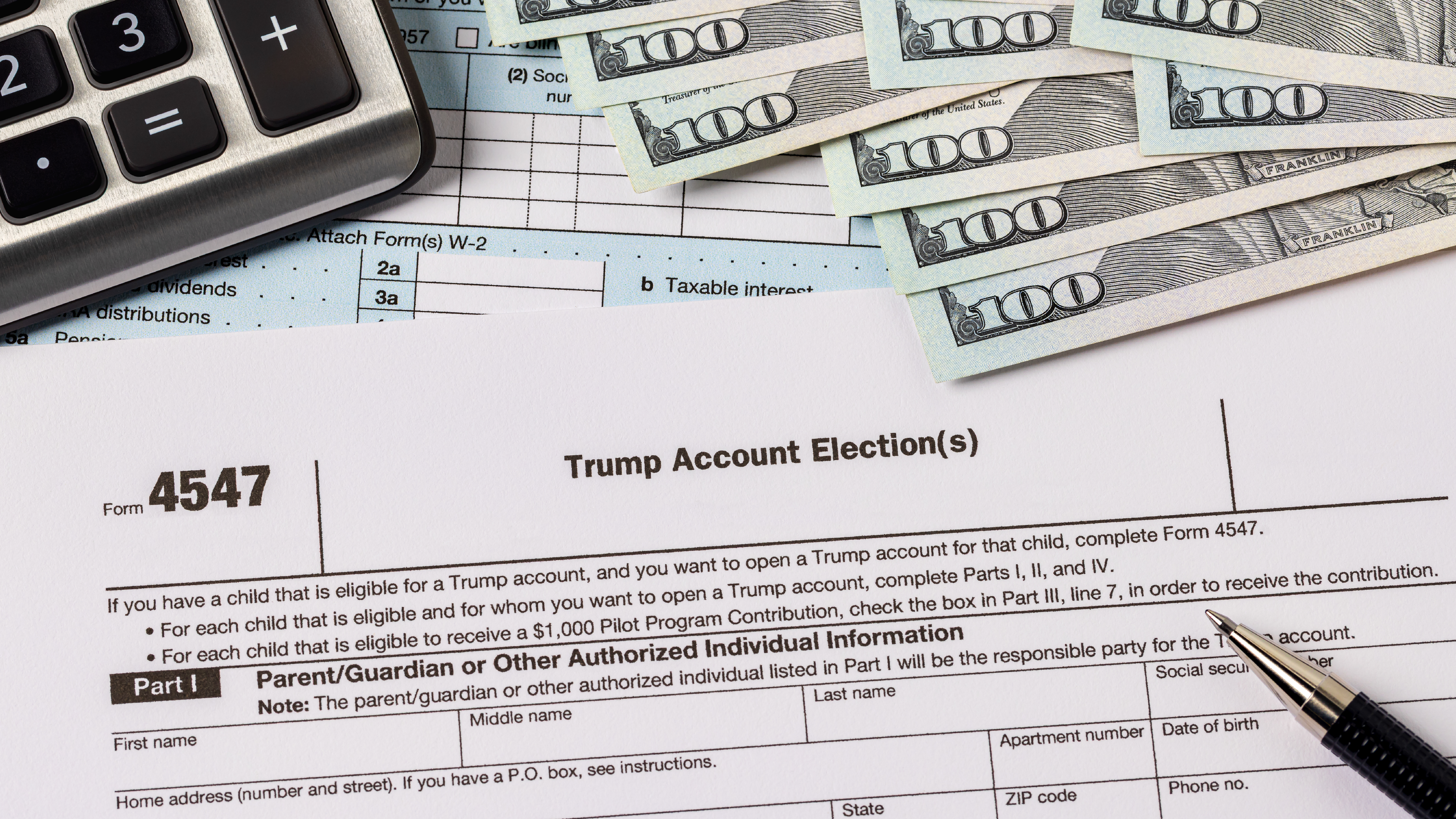
A formal election to establish a Trump account is required before any contribution can be made. This election is available by filing IRS Form 4547, using an IRS website: form.trumpaccounts.gov, or the “Trump Account” app. A separate election, by any of those methods, also must be made for someone claiming the $1,000 federal government contribution. This election can only be made by a person who anticipates that the eligible child will be his legal dependent for the year the election is made. One account per child is permitted, and the IRS regulations set strict rules for who is legally authorized to open it.
If the election to claim the $1,000 contribution is made at the same time as the election to establish the Trump account, then the person claiming the $1,000 contribution is also authorized to set up the account.
But if an election is being made to establish the account, but the $1,000 is not being claimed, the person authorized to establish the Trump account must be (in order of priority): the child’s legal guardian, parent, adult sibling, or grandparent. This means that a grandparent may not be legally able to open a Trump account for a grandchild unless there is no parent (or legal guardian or adult sibling) available to do so.
Six million children had already been enrolled in Trump accounts before a single contribution was legally permitted, reported Treasury Secretary Scott Bessent on May 29, 2026, where he described Trump accounts as “the most important benefit to young people since the GI Bill.”
The government website went live months earlier, the form was two pages, and buried inside the IRS regulations, not on the form and not on the website, was a hierarchy rule that some of the people who signed were violating without knowing it, because they were not the parent or legal guardian. Yet, the form still accepted their signatures.
If no account has been opened, this conversation belongs with an advisor who knows these rules in depth, not a government website that does not mention them. An advisor trained in IRA and retirement account law can confirm who has authority to open the account, whether the child qualifies for the federal seed, and how a Trump account fits alongside any 529 plans already in place for the same child. The form will not stop anyone from signing incorrectly. An advisor who knows these rules will.
More on Retirement Planning
- Find out what consumers are looking for in their advisor
- How can reverse mortgages be leveraged in retirement
- Strengthen your retirement planning knowledge with Ed Slott & Company's IRA Success Program
Related Posts